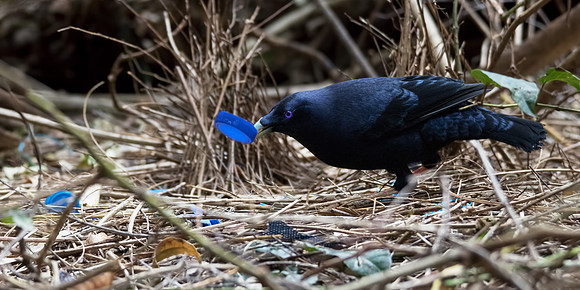
Ptilonorhynchus violaceus (Satin Bower Bird) ICUN Status: Least Concern Bowerbirds (family
Ptilonorhynchidae) are a group of 20 species that are found in Australia and New Guinea. Satin bowerbirds range down the east coast from Gympie to the south coast of Victoria, and west just past the ranges. There is also a small isolated population in northern Queensland from Townsville to just north of Cairns.
The layout of the bower for this species involves a cleared area in which a bed and two parallel walls are constructed out of twigs. The bed around the walls is decorated with items the male collects (blue and sometimes yellow). Females inspect the bowers of the males in their range over a period of time: initially while the male is absent, then while he is present and displaying, finally culminating in copulation with a single male whose bower and display won out.
The collection decorating the bower is particularly interesting. Lots of articles talk about berries and flowers being used, but all the bowers I’ve seen have been dominated by man-made objects like straws and bottle tops. In the case of satin bowerbirds this is hardly surprising given their proclivity for blue, and the
difficulty nature has producing that colour.